The 12th annual Good Merger Index (GMI) reveals a record-breaking year for charity mergers as financial pressures reshape the sector.
The Good Merger Index 2024/25, the annual review of merger data across the charitable sector in England and Wales which was released on 11th March 2026 revealed the highest number of charity mergers in the Index’s 12-year history.
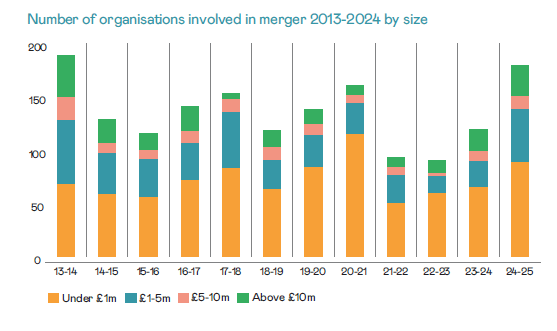
Between May 2024 and April 2025, there were 94 mergers involving 183 organisations – a 49% rise on the previous year and almost double the activity seen in 2022/23 which followed 2 years of record low levels of activity during COVID-19.
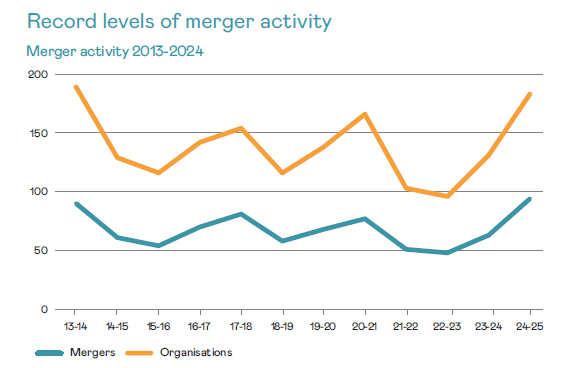
The findings reflect a sector undergoing profound restructuring as charities respond to rising demand for their services, economic uncertainty and persistent financial strain. This strain is driven by cuts in public sector funding, declining donations and increasing operating costs in areas such as employment, energy, food, rent and service delivery.
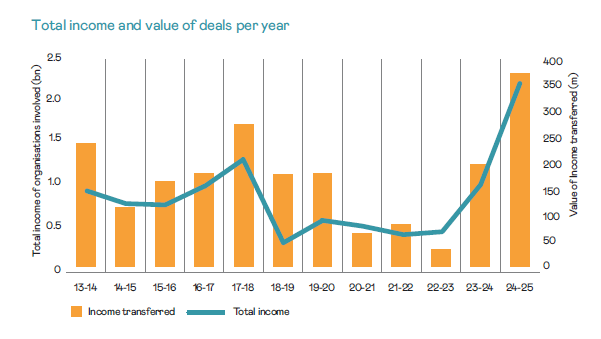
The report identifies an 111% increase in the total income of organisations involved reaching £2,181 million, while the total value of services and activities transferred soared to £362m, an 84% increase year-on-year.
Independent schools and small charities drive sharp increase in mergers
A major factor behind this year’s surge is the consolidation of the independent schools’ sector, which accounted for 13 of the 20 largest mergers. VAT changes, cost pressures and declining fee income have accelerated activity at a pace not previously seen.
At the same time, merger activity amongst small charities (under £1m turnover) has risen significantly, highlighting ongoing pressure on local organisations delivering essential community services. Over half (56%) of transferor organisations – those being acquired or merging – were in deficit in the year before merger, confirming that financial necessity is increasingly driving organisations to seek a stable partner.
Takeovers dominate charity mergers as charities pursue resilience
Takeovers continue to be the most common form of merger. The data suggests that many smaller charities are seeking a ‘safe harbour’ within stronger organisations, particularly in health, social care, disability and family support services.
However, the GMI also shows that many mergers are strategic rather than reactive, with boards pursuing growth, digital transformation, improved efficiency and wider impact.
Charity merger case studies highlight innovation and mission-led decision making
The report features powerful case studies illustrating different merger pathways:
Mental Health Innovations and The Mix chose to merge and create a unified digital mental health offer for young people, enabling them to work as one under two different brands.
“We realised we were competing for the same funding, even though we were trying to solve the same problems. It made sense to join forces – not just to be more efficient, but to be more impactful.”
Victoria Hornby CEO of MHI
“Our shared history meant we were well placed to understand how we could bring our services together for greater impact and to take better advantage of the opportunities offered by new technologies to achieve this.”
Chris Martin ex CEO of The Mix (now CEO of MQ Mental Health Research).
PACEY completed a fast, criteria-led partner search to find a suitable larger charity (CORAM) that could sustain and strengthen their role as a champion for childminders amid sector-wide funding decline.
“The direction of travel in early years funding was very clear after the pandemic. We needed to act, but we needed to act in a way that protected our members and our integrity. This wasn’t about finding any partner – it was about finding the right one.
Helen Donohoe, Ex Chief Executive PACEY.
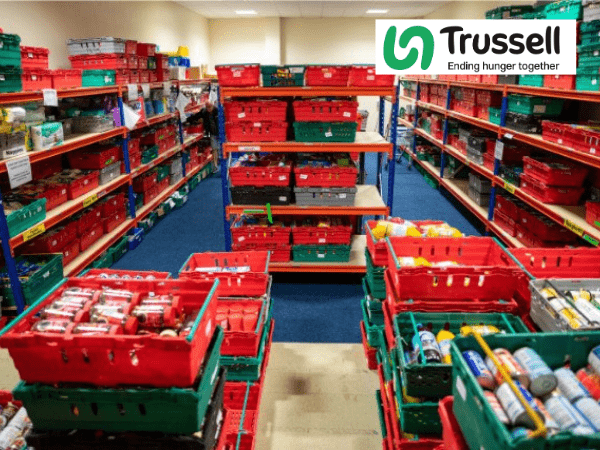
Trussell found a new home for their small but resource-intensive retail arm at Shaw Trust. This approach delivered a values-led divestment which allowed Trussell to refocus on mission while also ensuring continued support for the staff and local communities impacted.
“A structured approach helped us stay focused on finding the best organisation to take over the retail portfolio, while flexibility meant we could adapt as needed. We are proud of the outcome. Trussell Retail Limited (TRL) has found a new home with an organisation that shares our values.”
Tina Higgs, Director of Finance, Trussell.
“We have managed to achieve a fantastic result that has given the services a bright future and new home. This story really is a win-win for both organisations, but more importantly for the individuals that they support.”
James Robertson, Chief Financial Officer Shaw Trust.
A sector finding new ways to survive and thrive
The Good Merger Index highlights that while 2024/25 has been a difficult year for many charities, merger has increasingly become a practical and proactive tool for sustainability, innovation and impact.
Eastside People encourage boards, funders and policymakers to recognise mergers as one part of a broader resilience strategy—and to engage early when exploring partnership options.
Read the full press release
Download the Good Merger Index