Blog by Eastside People CEO Richard Litchfield.
Strap yourself in, hold tight, and get ready folks—2026 promises a wild roller-coaster ride for charity leaders.
I argue that it will continue to be defined by converging forces — political, economic, cultural and technological – while organisations operating at the edge of sustainability are being asked to do more, with less.
The Charity CEO does not have an easy brief but there are opportunities to be creative, diversify income, collaborate more and become agenda-setters. This blog explores five trends shaping the landscape in 2026 — and what they mean for those leading charities of all shapes and sizes.
- Politics: Polarisation, Extremism and a Harder Operating Climate
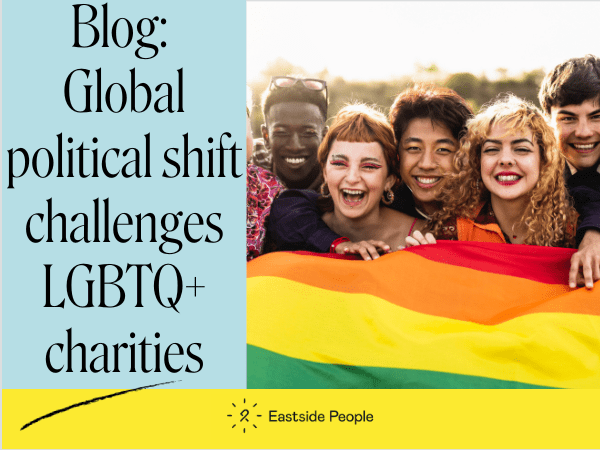
The political environment for charities is becoming markedly more hostile. Continuing polarisation, the erosion of rights and the rise of extremism are reshaping public discourse, with charities increasingly drawn into culture wars they did not choose. In a blog written as part of our ESG Insights report, Dr Alex Rhys, Chief Executive of It Gets Better UK writes about the Equity, Diversity and Inclusion (EDI) challenges facing LGBTQ+ organisations.
In the UK, the sluggish performance of Labour alongside the rise of Reform has created uncertainty about the future policy environment.
Meanwhile, anti-charity rhetoric and policies are on the rise. International aid cuts which started in the US and moved to the UK continue to reverberate. A recent Gates Foundation report warned that around 200,000 more children under the age of five are projected to die across the world due to the unprecedented aid cuts.
At the same time, charities themselves are facing rising threats of harassment and abuse, particularly those working with minorities and in contested or politicised spaces. As Mark Simms, interim Chair of the Charity Commission, observed charities “are living in a pervasive climate of fear, with staff feeling uncomfortable simply getting to and from work”.
While the operating climate is harsher, it will also force a necessary shift. In 2026, there is an opportunity for the sector to collaborate more so that collective voice becomes a source of resilience and influence.
Leadership implications for 2026:
- Charity leaders must invest in risk assessment, safeguarding and security, including for senior leaders and frontline staff
- Boards need to be confident about political literacy — understanding what can and cannot be said, and when silence is itself a risk
- There is a growing opportunity for collective voice and alliances, rather than organisations standing alone or neutral. See for instance Third Sector Against Transphobia Take action.
- NHS Restructuring: Opportunity and Uncertainty for the Voluntary Sector
The restructuring of the NHS — including cuts to NHS England and Integrated Care Boards (ICBs) — is creating significant disruption. At the same time, the NHS 10-Year Plan’s renewed emphasis on prevention offers an opportunity for the voluntary and community sector to play a more central role. After all prevention aligns strongly with what charities already do well.
However, many health and social care charities are trying to figure out their place in the system amid shrinking budgets, unclear commissioning routes, and a lack of consistent national leadership.
Social care charities are caught in the gap between ambition and reality: expected to deliver preventative, community-based solutions without long-term funding certainty or genuine system integration.
In 2026, the opportunity lies in claiming this space with confidence — and helping define what effective prevention actually looks like.
Leadership implications for 2026:
- There is an opportunity for charity leaders to become system navigators not just service providers
- Investment in relationships with ICBs and local authorities will be essential, even as those bodies themselves are under strain
- There is a growing case for charities to articulate — clearly and confidently — what prevention really requires and what outcomes they are delivering at a population level.
- Culture Wars: When Neutrality Is No Longer an Option
Organisations like Girlguiding and the Women’s Institute have found themselves at the centre of anti-trans activism and wider culture wars, often driven by well-organised external groups. For many charities, this has shattered the assumption that being “apolitical” offers protection.
In reality, 2026 demands strong public leadership alongside careful and proactive planning. Leaders are being forced to decide not just what their values are, but how — and when — to defend them.
This is also playing out through a broader class war narrative, where charities are criticised either for being “out of touch elites” or for failing to take sides strongly enough.
Leadership implications for 2026:
- Boards and executive teams must align on values, red lines and response strategies before crises hit
- Leaders need support to manage personal exposure, including media training and peer networks
- There is an opportunity to be bold because silence carries risks too — leadership now involves choosing when to speak out and how in order to further the impact of the causes our charities represent.
- Economic Conditions: Leading Through Contraction and Change
The economic environment remains difficult. Changes to National Insurance and the Living Wage have affected budgets with financial implications carrying over into 2026 and beyond. As a result, the sector has seen major charities from Stonewall to Oxfam announce significant redundancies alongside a wave of closures — particularly among infrastructure organisations.
UK grant-makers are also under intense pressure, with some closing their endowments, and others narrowing funding criteria, resulting in demand far outweighing supply. In Barely Civil Society, Alex Evans notes funds saw “between triple and in one case almost 200-fold increases in applications”.
The result is a perfect storm: rising demand, shrinking resources, and less funding in the system. In this context, change and transition will become the norm for the charity leader. This also provides an opportunity to seize the moment. Mergers, closures, restructures and pivots — while painful — can lead to stronger, more focused organisations.
For the first time in years, the sector is talking openly about stopping work that no longer delivers impact and about reshaping organisations. In 2026, the opportunity is not survival at all costs, but purposeful reinvention.
Leadership implications for 2026:
- The sector should continue talking honestly about ending, pausing or transforming work, not just scaling it
- Leaders have more permission than ever before to reimagine the shape and size of their organisations
- Change leadership, emotional intelligence, and clear communication are now core skills, not “soft” ones.
- AI: Risk, Opportunity and Responsibility
AI is already reshaping fundraising, service delivery, communications and internal operations. In 2026, the question is not whether charities will use AI, but how thoughtfully and ethically they do so.
AI offers real opportunities: automating routine tasks, improving insight, supporting overstretched teams. But it also raises risks around bias, data protection, misinformation, and the erosion of trust — particularly for charities working with vulnerable communities.
Leadership implications for 2026:
- Boards must treat AI as a strategic and ethical issue, not just a digital one
- Leaders should focus on augmentation, not replacement — using AI to support human service delivery, not remove it
- Transparency about how AI is used will be essential to maintaining public trust.
Conclusion: Leadership in 2026 Is About Courage and Clarity
The defining feature of charity leadership in 2026 will be courage under pressure. Leaders are being asked to hold values steady in a more hostile environment, make decisions with imperfect information, and care for people through relentless change.
2026 will not be easy but there are opportunities. It will reward leaders who are honest, creative, and willing to lead — even when the ground is shifting around them.
At the Festival of Trusteeship in November 2025, we gathered over 1600 charity trustees to learn and share insights about good governance. It reminded me that governance is the platform to manage successful change. If the relationship between the Board and the Executive is healthy, then leaders can talk honestly about problems, be proactive, plan together, and then communicate with courage, consistency and clarity.
My hope is that it’s also the year in which we grasp the nettle on collaboration recognising that collective power instead of neutrality or isolation enables us to shape more resilient, trusted, and impactful organisations.
Got any questions? Get in touch today.