Read the Questions and Answers from our online roundtable that explored the strategic, governance and legal considerations involved in developing and managing charity group structures.
The session was chaired by Cara Evans, Head of Partnerships & Mergers at Eastside People, and featured expert insights from Dame Carol Homden DBE, Chief Executive of Coram, Jez Todd, Managing Director of Coram Family Lives and Gareth Roy, Partner in the Charity Law & Governance Team at Wilsons Solicitors LLP.
The discussion covered why charities choose group structures, governance arrangements, board composition, risk management, funding considerations and practical lessons from organisations that have already made the transition.
You can watch a recording of the panel discussion and download the slides presented during the session on our Charity Group Structures resource here.
Below is a summary of the questions raised and the responses from the panel.
- Why are some organisations divesting their retail operations?
An attendee asked why some organisations are choosing to separate or divest retail activities.
Cara Evans explained that the reasons vary considerably between organisations. In many cases, decisions are driven by strategic priorities, financial considerations or organisational restructuring. She pointed attendees towards Eastside People’s case study on the transfer of retail operations from Trussell to the Shaw Trust as an example of how charities have approached this issue and the lessons learned from the process.
- Could two or more charities create a jointly owned subsidiary to share services (backroom or retail services for example)?
A participant asked whether two or more charities could establish a jointly owned company to provide shared services such as retail or back-office functions. He was referring to models 3. or 4. In the diagram below.
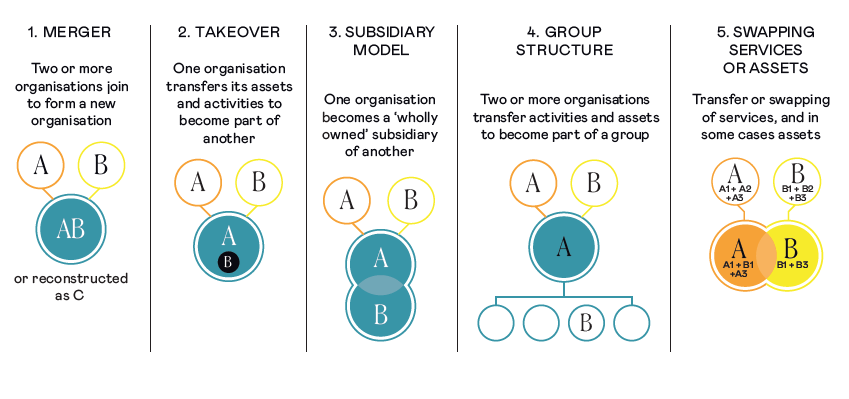
Dame Carol Homden confirmed that this approach is entirely possible. She explained that organisations within the Coram group share centrally provided services, while also operating as wholly-owned trading subsidiaries at both group and individual entity level. Group structures can therefore provide a practical framework for collaboration without requiring a full merger.
- Do funders’ turnover limits/income thresholds discourage charities from forming group structures due to the risk of becoming illegible for funding? Is this a barrier to consolidation and collaboration in the sector, and should funders be taking a different approach?
Some attendees highlighted that certain grant programmes have turnover limits, which can make charities concerned about becoming ineligible for funding if they merge or join a group.
Dame Carol noted that, where charities continue to exist as separately registered entities within a group structure, they remain independently audited and can continue applying for funding in their own right. This means that funding eligibility may not necessarily be affected in the way some organisations fear.
- Have findings from a due diligence business case ever turned out differently in practice?
When asked whether due diligence and business case assumptions always prove accurate, Dame Carol said that reality frequently differs from expectations.
She highlighted people-related issues, such as long-term sickness, as an area where unforeseen challenges can emerge. She also noted that assumptions about future business opportunities do not always develop as anticipated, reinforcing the importance of thorough due diligence and ongoing review.
Dame Carol stated that the most important thing for organisations to remember is that the duty of the board is to the purpose of the organisation, not to the staff members or the particularity of how the organisation operates.
She listed 4 the most important Ps that all organisations should consider:
- Purpose: Strategic fit and values fit. From her experience, when discussions have taken place that did not succeed, it’s often a failure of purpose fit. Dame Carol cited an organisation that dealt with adult perpetrators rather than child victims as an example of an organisation that did not fit Coram’s purpose.
- Pensions: A first due diligence question should always be about the situation and commitments around pensions.
- Place: Ongoing lease commitments and staff working arrangements (such as working from home) should be key considerations.
- People: The most important element. Although the interests must be driven by the purpose, the detail of the expertise needed to maintain service resilience and continuity is vital. Who and how are the trustees? Trustee exhaustion is a common phenomenon, especially in smaller organisations that often find it difficult to recruit and refresh trustees which can impact decision-making.
5. How do conversations about creating a group structure begin?
An attendee asked how Coram approached discussions when first creating its group structure.
Dame Carol explained that the starting point was establishing clear principles from the parent organisation. These principles reflected the parent body’s responsibilities for protecting assets, safeguarding governance and creating clear accountability and management structures..
She emphasised the importance of clarity regarding responsibilities and decision-making authority from the outset and being clear about what is and isn’t open for negotiation.
- How do leaders manage multiple governance responsibilities across a group structure?
A question was raised about balancing the responsibilities associated with being a chief executive, company secretary, trustee or director across different entities.
Dame Carol clarified that she is not a trustee of any of the charities within the Coram group but is a director of the trading companies. Serving as CEO and company secretary across the entities helps maintain integrated governance and consistency in decision-making.
- How can trustees and leaders encourage organisational change and be true agents of the charity at all times at the same time as being human with all its foibles?
One attendee asked how boards and senior leaders create an environment where people make decisions in the best interests of the charity, even when change may be difficult.
Dame Carol’s answer was succinct: “Inspiration and leadership.” She noted elsewhere during the discussion that one of the greatest challenges in organisational change is when people are unwilling to adapt. Charities that are not prepared to change may struggle to respond to the evolving needs of beneficiaries and operating environments.
- Do group structures always emerge from mergers?
A participant asked whether organisations generally arrive at group structures through merger activity saying that they had options but wanted to weigh the pros and cons of breaking existing services into discreet business units as part of a group structure in order to grow and consider future partnerships.
What should be considered?
Dame Carol’s response was clear that this is not the case. While mergers can lead to group structures, there are many other routes. Some organisations establish group arrangements to support future growth, improve resilience, facilitate partnerships or separate activities into more focused entities.
- What is the right balance between shared members of boards and independent trustees on each board?
Several attendees were interested in governance arrangements and board composition.
During the discussion, both Gareth Roy and Dame Carol emphasised the importance of trustee overlap between parent and subsidiary entities. Gareth described cases where a lack of overlap had led people to lose sight of the purpose of the structure over time, creating governance problems. Dame Carol noted that cross-serving trustees provide a valuable early warning system and help maintain alignment across the group.
At the same time, Coram ensures that subsidiary charities maintain a majority of non-cross-serving trustees to enable them to fulfil their fiduciary duties appropriately.
Gareth explained that the subsidiary charity should be able to form a quorum of trustees who are not connected to the parent charity, to ensure conflicts of interest can be properly managed.
- What happens when governance arrangements are not set up properly?
Both Gareth Roy and Dame Carol shared examples where organisations experienced governance difficulties because structures had not been established clearly from the beginning.
Gareth described a situation where there was no board overlap and a lack of clear communication, leading to confusion and loss of strategic alignment. Dame Carol cited examples where organisations had even lost effective control and oversight of trading subsidiaries because governance mechanisms were insufficiently integrated.
The panel agreed that while parent organisations often retain constitutional powers to intervene when necessary, fixing governance problems later can be significantly more difficult than getting the structure right from the outset.
- Are charities increasingly choosing asset and liability transfers as consolidation models as opposed to other options?
Attendees observed growing levels of consolidation activity involving the transfer of assets, liabilities and business operations, often for cost-saving purposes.
Dame Carol agreed that this reflects current market practice and can be an effective way of protecting organisational integrity and purpose and preserving services while improving long-term sustainability.
- Do group structures work when there are only two organisations? Setting up the parent organisation (assuming that it would be new in this scenario) is a lot of effort to manage only two subsidiaries and no plans to add more).
Is a group structure worthwhile when only two organisations are involved?
Gareth Roy said he saw no reason why such an arrangement would not work. Dame Carol added that Coram itself started with a very small group structure before growing significantly larger.
She argued that the key benefit is resilience. For example, a single organisation may depend heavily on one fundraiser or specialist member of staff, creating considerable risk if one or more of those individuals leaves the organisation. Group structures allow expertise and infrastructure to be shared across organisations, reducing vulnerability and increasing capacity.
As Carol put it, strengthening expertise and infrastructure across organisations can mean that the whole becomes much stronger than its individual parts.
- How long does integration typically take after joining a group structure? Attendees raised the concern that an “acquired” organisation would simply immediately cease to exist immediately.
While the panel felt that there isn’t a standard timeframe for integration, Jez Todd noted that organisational decline and closure rarely happen suddenly. In his experience, these challenges have often developed over a period of three to five years, meaning that there is usually time for organisations to consider strategic options and partnerships before circumstances become critical.
It is important that all trustees are able to recognise the signs of decline and put the best interests of their service users to the forefront of their planning by pro-actively starting to do something about the situation before it becomes an emergency.
- How many trustees or directors should organisations have?
An attendee asked the panel if they could recommend an ideal number of directors within a group structure.
Dame Carol rejected the idea of a standard number. Instead, she argued that boards should have enough people on them to be able to provide the expertise needed by the organisation.
In a group structure, specialist governance, finance, investment and nominations expertise can be concentrated at parent level, enabling subsidiary boards to remain more focused on the specific services and activities they deliver. This allows organisations to access a wider range of skills without unnecessarily duplicating them across multiple boards.
- What is the biggest challenge in creating and managing group structures?
The panel highlighted several recurring themes:
- Dame Carol identified resistance to change and unresolved performance issues as two of the biggest barriers
- Gareth emphasised the difficulties that arise when governance arrangements lack clarity or oversight
- Jez focused on situations where organisations cling to existing structures rather than thinking creatively about how best to preserve and strengthen services for beneficiaries.
Collectively, the discussion reinforced the importance of honest conversations, strong leadership, a willingness to adapt and to put the impact on beneficiaries above all other concerns.
- What single piece of advice would the panel give organisations considering a group structure?
To conclude the roundtable, Cara Evans asked each speaker to share one key piece of advice.
Jez Todd: Start now. If a group structure is already being considered, prioritise the conversation and begin exploring options immediately. Jez stressed the importance of governance-level discussions, succession planning and giving organisations enough time to evaluate opportunities properly.
Gareth Roy: Set the structure up properly from the start. Governance arrangements should be clear, understood by everyone involved and capable of remaining effective as people and circumstances change.
Dame Carol Homden: Focus on strength, trust and complementarity. Organisations should be realistic about the assets, expertise and infrastructure they bring to a partnership and ensure that any combination creates something stronger than the individual organisations alone. Leaders must also be trusted to guide the transition successfully.
Watch the webinar recording
If you missed the event, you can watch the recording and access the presentation slides on Charity Group Structures resource page. The session provides valuable insights for charity leaders, trustees and senior managers considering mergers, partnerships or alternative group structure arrangements as a route to greater resilience and impact.
Visit our Merger and Partnerships Resources Hub to find our Charity Merger Guide and other related blogs, case studies, research reports, how-to guides, tips, news and client testimonials.